Cloud9 IDE
Easy way to drive your devices from the world
http://c9.io/
Showing posts with label sensor networks. Show all posts
Showing posts with label sensor networks. Show all posts
May 7, 2012

Jan 2, 2012
Nov 1, 2011
Vehicle Traffic Monitoring Platform with Bluetooth Sensors over ZigBee
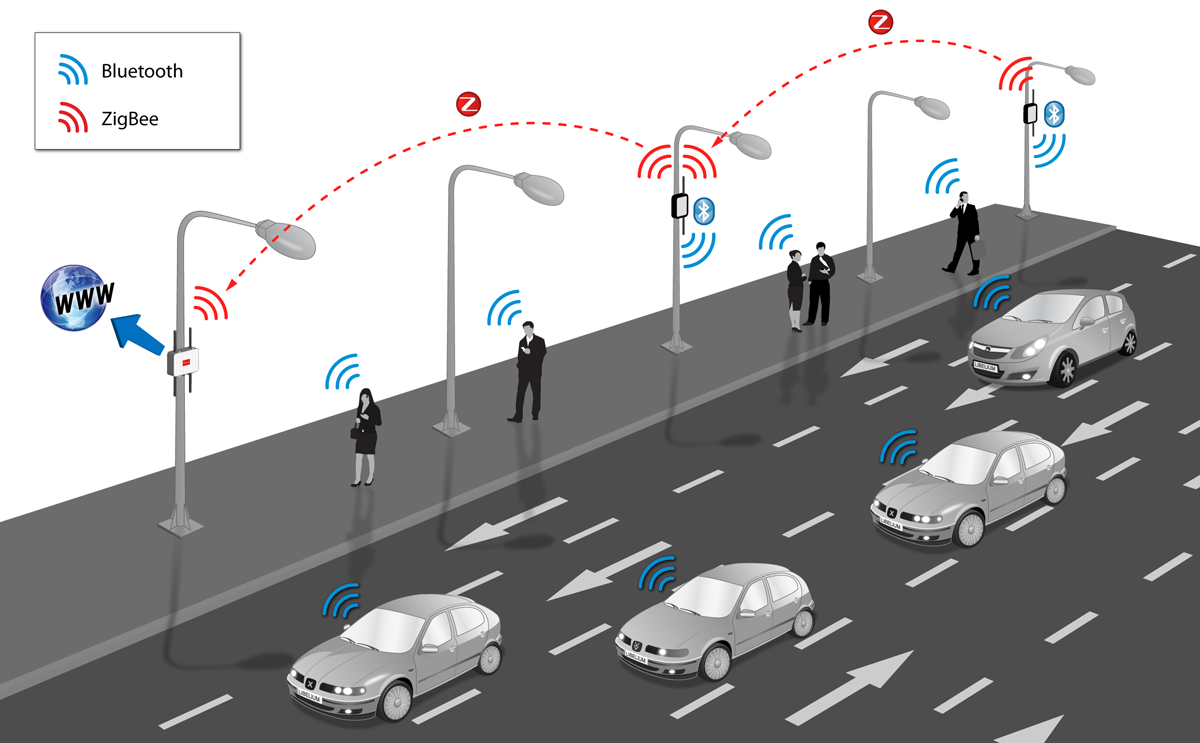
http://www.libelium.com/vehicle_traffic_monitoring_bluetooth_sensors_over_zigbee
Jun 16, 2011
An autonomous wireless sensor network for space applications
The importance of wireless sensor networks for space missions is shown in multiple applications, such as assembly, equipment integration, thermal and vibrations test phases in order to monitor the satellite. The high number of sensors required in space applications underscores the need for wireless sensors that save time during integration due to their simpler links and connections.
ASTRAL, which stands for Autonomous System and TRAnsmission wireLess sensor network for space applications, is designed to develop a demonstrator to validate the concept of adapting wireless technology for space missions. The result was a demonstrator for monitoring vibration in satellites on the ground and during the launch over approximately 30 minutes.
More: http://www.eetimes.com/design/military-aerospace-design/4216985/An-autonomous-wireless-sensor-network-for-space-applications?pageNumber=0
ASTRAL, which stands for Autonomous System and TRAnsmission wireLess sensor network for space applications, is designed to develop a demonstrator to validate the concept of adapting wireless technology for space missions. The result was a demonstrator for monitoring vibration in satellites on the ground and during the launch over approximately 30 minutes.
More: http://www.eetimes.com/design/military-aerospace-design/4216985/An-autonomous-wireless-sensor-network-for-space-applications?pageNumber=0
Jun 4, 2011
How to join to WSN throuh internet
Pachube is a realtime data infrastructure platform for the Internet of Things, managing millions of datapoints per day from thousands of individuals, organisations & companies around the world. Pachube's powerful and scalable infrastructure enables you to build 'Internet of Things' products and services, and store, share & discover realtime sensor, energy and environment data from objects, devices & buildings around the world.
https://www.pachube.com/plans
Open.Sen.se is an open platform for all those who want to imagine, prototype and test new Devices, Installations, Scenarios, Applications for this globally interconnected and immersive world. Designers, developers, tinkerers, students, hobbyists, R&D departments, artists, self quantifiers, dataviz maniacs, whatever your skills are, we tried to make Open.Sen.se easy to use and yet powerful for you. Needless to say
Open.Sen.se is free.
http://open.sen.se/
https://www.pachube.com/plans
Open.Sen.se is an open platform for all those who want to imagine, prototype and test new Devices, Installations, Scenarios, Applications for this globally interconnected and immersive world. Designers, developers, tinkerers, students, hobbyists, R&D departments, artists, self quantifiers, dataviz maniacs, whatever your skills are, we tried to make Open.Sen.se easy to use and yet powerful for you. Needless to say
Open.Sen.se is free.
http://open.sen.se/
Mar 10, 2011
LiteOS - OS for sensor networks

The LiteOS 2.0 is the latest beta version of LiteOS. It runs on the following platforms: X86/Windows XP/Vista or Linux, MicaZ or IRIS as the target mote platform, and MIB510/MIB520 as programming boards.
Funding acknowledgement: The LiteOS Project is currently supported by NSF grant CNS-0953238 (2010-2015), and was supported by NSF grant CNS-0626342, and Vodafone Fellowship (2007-2009).
http://www.liteos.net/
Feb 2, 2011
Sensium ultra-low power platform for rapid development of wireless Body Area Networks (BANs)

A basestation can wirelessly link up to 8 target stations, each monitoring multiple physiological signals on the body.
TZ1030 Ultra Low Power Intelligent Sensor Interface and Transceiver
Nearly all the electronics and firmware for Sensium life platform sensor nodes or basestations are integrated on to a system on chip called theWireless Sensing In High Alpine Environments

Jan 27, 2011
realtime WSN

FireFly is a low-cost wireless sensor network platform capable of data acquisition, processing & multi-hop mesh communication. Each battery-operated node functions with scalable & economical global time-synchronization and delivers a lifetime of 1.5-2 years. Fixed and mobile nodes can dynamically form a network and facilitate applications such as utility monitoring, surveillance, location tracking and voice communication. It is easy to add-on custom modules for user-specific applications.FireFly runs the Nano-RK real-time sensor operating system for easy deployment.
Dec 21, 2010
RUNES middleware

Dec 20, 2010
ANT is rising

ANT provides a simple, low cost and low power solution for short range wireless communication in point-to-point and more complex network topologies. Suitable for many applications, ANT is today a proven and established technology for collection, automatic transfer and tracking of sensor data within sports, wellness management and home health monitoring applications.
Dec 18, 2010
Nanotron Localization module
nanoLOC AVR Module

This smart nanoLOC AVR Module is only 35 mm by 14 mm and less than 3 mm thick. Yet, within this small form factor it integrates all the required components for a complete RF module based on Nanotron’s innovative nanoLOC TRX Transceiver. This module uses the Atmel AVR ATmega644 microcontroller and includes a band pass filter, a balun, and an integrated 2.4 GHz chip antenna.
Due to the chip’s unique chirp pulse, adjustment of the antenna is not critical. This significantly simplifies the system’s installation and maintenance (“pick and place”). A sophisticated MAC controller with CSMA/CA and TDMA support is included, as is Forward Error Correction (FEC) and 128 bit hardware encryption. To minimize software and microcontroller requirements, nanoLOC also provides scrambling, automatic address matching, and packet retransmission.
Dec 16, 2010
Large-Scale Demonstration of Self-Organizing Wireless Sensor Networks

On Aug. 27, 2001 researchers from the University of California, Berkeley and the Intel Berkeley Research Lab demonstrated a self-organzing wireless sensor network consisting of over 800 tiny low-power sensor nodes.
Sensor nodes was based on TinyOS.A network discovery operation would show yellow briefly as the discovery wavefront propagated across the network and then turn off the red LED. Because the discovery takes only a fraction of a second, we would then issue a sequence of commands to illuminate level 1, then level 2, etc. at five second intervals. Test runs in a near empty auditorium discovered a network of 800 nodes that was four levels deep.
Visit http://webs.cs.berkeley.edu/800demo/
Subscribe to:
Posts (Atom)